Why math fact fluency matters
When 7 × 8 is just there, a child’s attention is free for the hard part of the problem. When it isn’t, every multi-step problem becomes a pile-up.
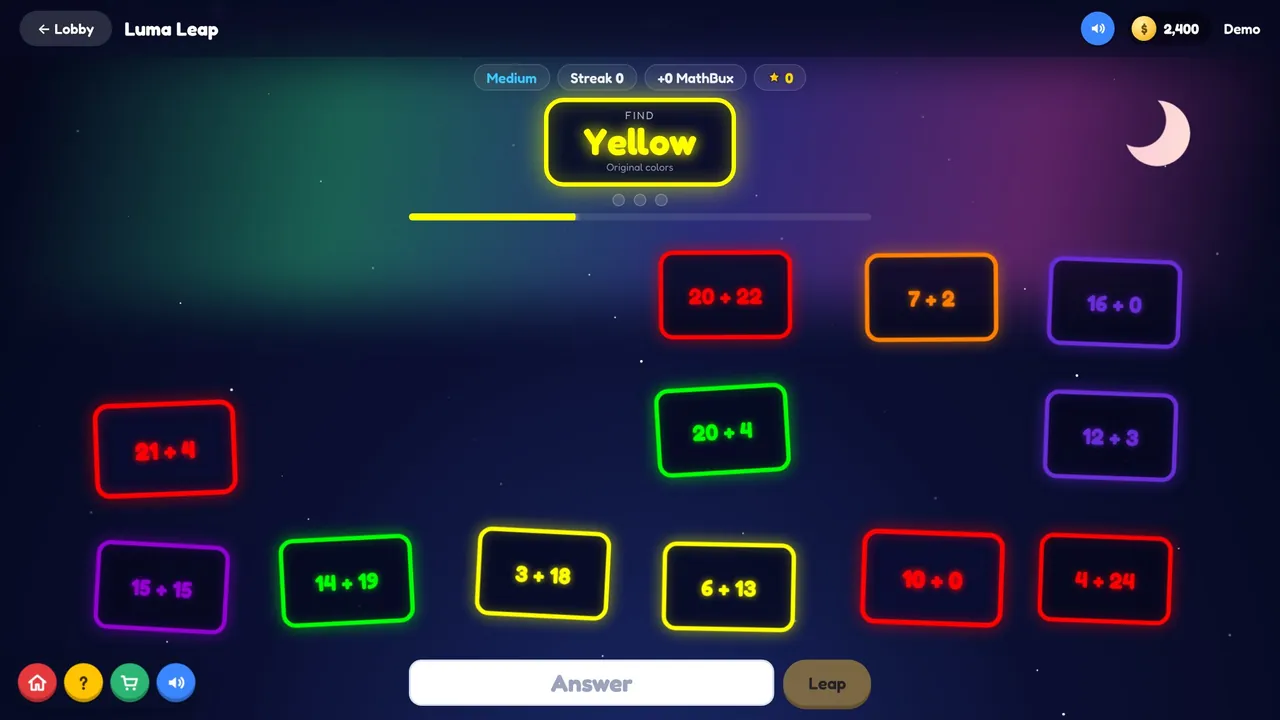
Fluency is more than speed
A child who is fluent with a fact knows it accurately, recalls it quickly and doesn’t have to count it out. Counting on fingers or skip-counting gets to the right answer, but it uses up the working memory a child needs for long division, fractions and word problems.
That’s why the U.S. National Mathematics Advisory Panel called quick and effortless recall of facts a critical foundation for algebra, and why the Institute of Education Sciences recommends that math intervention set aside time in every session to build fluent retrieval of basic facts.
A brain-imaging study followed the same idea into high school: how students’ brains handled single-digit arithmetic, including how much they relied on fact retrieval, was related to their PSAT math scores years later.
How Mighty Mathletes builds it
Many short, spaced rounds
Memory research finds that recalling something (rather than re-reading it) and spreading practice out over days both make learning stick. Every Mighty Mathletes game is built from quick recall, and the daily session and quest goals bring kids back a little at a time instead of all at once.
Mastery you can trust
A fact only counts as mastered after a child has answered it correctly 20 times with 92% accuracy or better (10 times for doubles like 6 × 6). One lucky guess doesn’t move the needle; consistent recall does.
The right facts for each child
Teachers, school leaders and parents choose which skills each child practices and how far each goes: addition and subtraction up to 15, 20 or 25, and multiplication and division up to 8, 10 or 12. A second grader and a fifth grader can play the same games with completely different facts.
Feedback in the moment
Every answer gets an immediate response in the game: the car speeds up, the potion fizzes, the egg is yours. Grown-ups get a running list of the specific facts each child keeps missing, so practice can be aimed where it helps most.
These studies are about how children learn math facts, not about Mighty Mathletes itself. They are why the program is designed the way it is. See the learning science for more.
Sources
- National Mathematics Advisory Panel (2008). Foundations for Success: The Final Report of the National Mathematics Advisory Panel. U.S. Department of Education. Read it
- Gersten, R., et al. (2009). Assisting Students Struggling with Mathematics: Response to Intervention for Elementary and Middle Schools (IES Practice Guide, NCEE 2009-4060). Recommendation 6: build fluent retrieval of basic arithmetic facts. Read it
- Price, G. R., Mazzocco, M. M. M., & Ansari, D. (2013). Why mental arithmetic counts: Brain activation during single digit arithmetic predicts high school math scores. Journal of Neuroscience, 33(1), 156–163. Read it
- Roediger, H. L., & Karpicke, J. D. (2006). Test-enhanced learning: Taking memory tests improves long-term retention. Psychological Science, 17(3), 249–255. Read it
- Cepeda, N. J., Pashler, H., Vul, E., Wixted, J. T., & Rohrer, D. (2006). Distributed practice in verbal recall tasks: A review and quantitative synthesis. Psychological Bulletin, 132(3), 354–380. Read it
- Hattie, J., & Timperley, H. (2007). The power of feedback. Review of Educational Research, 77(1), 81–112. Read it